
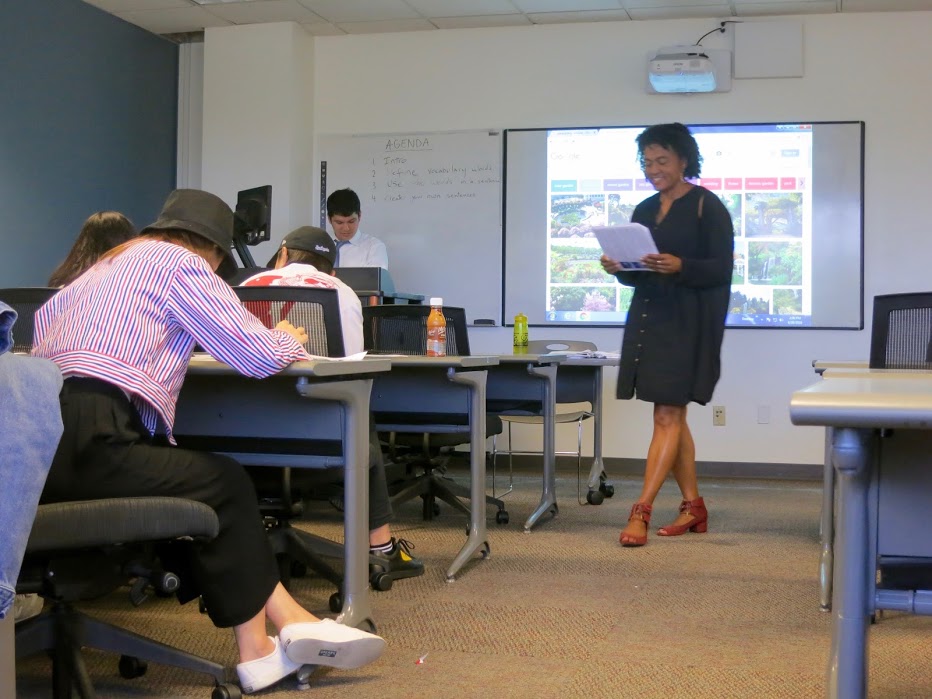
Teaching Philosophy –
by Sharon Mordecai
My goal as a teacher is to ensure my learners have the skills they need to successfully communicate with others both in written text and in conversation. I strive to see my learners graduate to express themselves and their needs to make informed decisions that benefit themselves, their families, and their communities.
I became a teacher because I believe communication and comprehension is the heart of everything we do. I look forward to developing learners to effectively communicate clearly to others in English in any environment, both professionally and casually.
I believe that it is my responsibility as a teacher to provide students with the tools to communicate clearly in English within the proven methods as stated by Lazaraton (2004), Second Language Speaking. These methods are – fluency, accuracy, appropriacy, and authenticity. Accuracy is conforming to the language rules, while fluency is using the language quickly in informal conversation interactions. By using the appropriate level of material, and including authentic resources, I not only give instruction and practice in using accurate grammar, vocabulary, reading comprehension, and writing skills, but also in creating a learning environment that uses real world materials, including being sensitive to the socio-cultural differences that exist between the learner and the native English speaker.
As explained in the study by Larsen-Freeman and Celce-Murcia (2004), The Grammar Book, I agree with the necessity to include the cultural aspects of communication. In my class environment I also feel the responsibility to my learners to inject authentic materials bringing cultural sensitivity awareness within my lesson activities so that learners will also become conscious that language is not only words, but it is a part of overall communication and interaction between peoples. As it is also concluded in Roberts and Cooke (2003), Skills for Life, the communication accuracy of a language can only be successfully delivered if the fluency and accuracy of a language is also inclusive of the authenticity of the materials.
When I teach, although the coverage of the material is crucial, I also keep in mind that it is also important to incorporate an interactive teaching style as defined by Brown (2007), Lesson Planning. He states that students learn best through an appropriate balance of teacher centric and student centric styles. My class would include the use of familiar games and activities that is appropriate for the learner’s level and socio-cultural environment. Jones (2007), The Student-Centered Classroom, reports that practice activities and games within learning context helps the students retain and reinforce learned information better – as in using local melodies with appropriate lyrics to retain grammar rules as opposed to a teacher centric or a traditional lectures. Games and activities also encourage cooperative learning and team building skills in group activities, which is critical to life skills in personal development. In the very least I strive to spark an eternal interest and confidence in my learners when communicating in English.
I look forward to becoming an instrumental part of a language institute system to equip students to effectively communicate to others in conversational fluency, accurate English context, and within accepted socio-cultural norms.